
If your goal is simple—get the highest financial support possible—then you’re asking the right question. But the answer isn’t as straightforward as “this one pays more.”
Both government-funded scholarships and private scholarships can be incredibly valuable. The real difference lies in how much they cover, what they expect from you, and the kind of opportunities they open up.
Let’s break it down clearly so you can decide which is the better fit for your goals.
What Are Government Scholarships?
Government scholarships are funded by national governments to support international students, often as part of diplomatic, educational, or development goals.
Popular examples include:
- Chevening Scholarship (UK)
- Fulbright Program (USA)
- DAAD Scholarship (Germany)
- Commonwealth Scholarship
What Are Private Scholarships?
Private scholarships are funded by:
- Companies
- Foundations
- Universities
- NGOs
Examples include:
- Mastercard Foundation Scholars Program
- Google Generation Scholarship
- Coca-Cola Scholars Foundation
Which Pays More? (The Honest Answer)
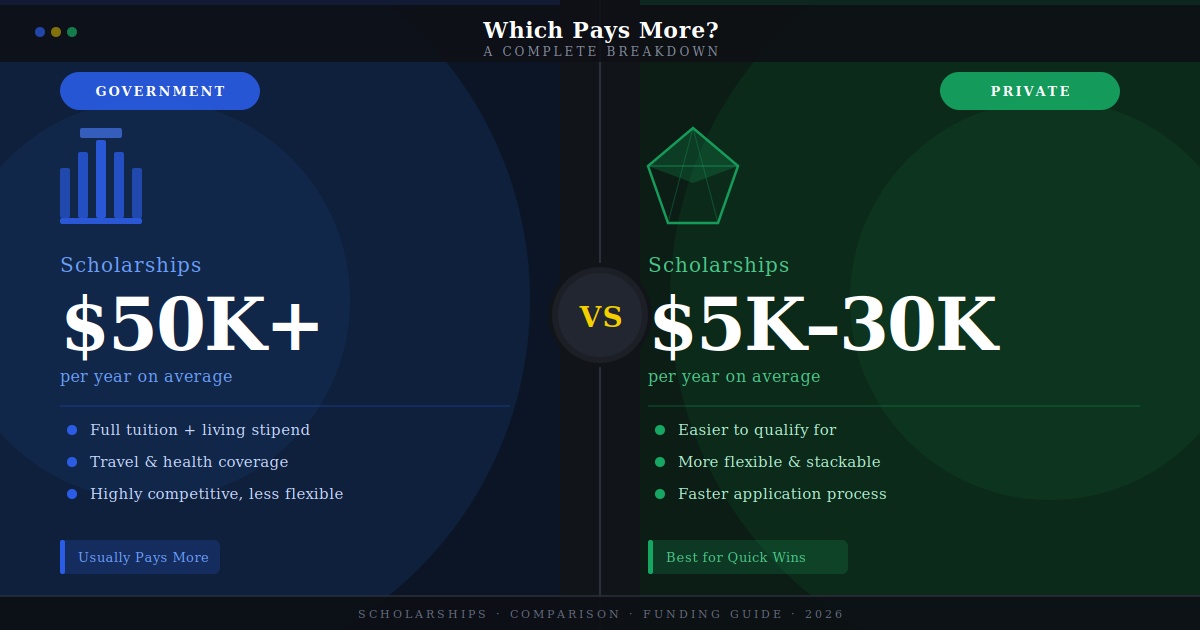
Government Scholarships: Usually Pay More (Overall)
In most cases, government scholarships offer the highest total value.
They often cover:
- Full tuition
- Monthly living stipend
- Accommodation
- Travel costs (flights)
- Health insurance
This makes them fully funded, meaning you can study with little to no out-of-pocket expenses.
For example:
- Chevening Scholarship covers nearly everything for a master’s degree
- Fulbright Program includes tuition, stipend, and travel
Verdict: If “paying more” means total financial coverage, government scholarships usually win.
Private Scholarships: Can Be High—But Often Partial
Private scholarships vary widely.
Some offer:
- Full funding (rare but possible)
- Partial tuition support
- One-time cash awards
For instance:
- Mastercard Foundation Scholars Program can be fully funded
- Google Generation Scholarship offers partial funding
However, many private scholarships:
- Don’t cover travel
- Don’t include accommodation
- Are one-time payments
Verdict: Individually, they often pay less—but you can combine multiple awards.
The Key Difference: Depth vs Flexibility
Government Scholarships = Deep Funding
Think of government scholarships as all-in packages.
Pros:
- Comprehensive funding
- Prestige and recognition
- Strong alumni networks
Cons:
- Extremely competitive
- Strict eligibility criteria
- Often tied to returning to your home country
Private Scholarships = Flexible Funding
Private scholarships are more like building blocks.
Pros:
- More options available
- Easier to apply for (in many cases)
- Can combine multiple scholarships
Cons:
- Often partial funding
- Less standardized benefits
- May require additional funding sources
Real-Life Scenario Comparison
Let’s say you’re a Nigerian student planning to study abroad.
Scenario A: Government Scholarship
You win the DAAD Scholarship
- Tuition: Covered
- Monthly stipend: Provided
- Flight: Covered
- Total value: $25,000–$50,000+ per year
Scenario B: Private Scholarships
You win:
- $5,000 from one foundation
- $3,000 from another
- $2,000 from a university
- Total: $10,000
- You still pay remaining costs
In this case, the government scholarship clearly pays more.
When Private Scholarships Can Outperform Government Ones
There are exceptions.
Private scholarships can “win” if:
1. You Combine Multiple Awards
Stacking 3–5 private scholarships can exceed a single government award.
2. You Target High-Value Programs
Some private programs (like Mastercard Foundation Scholars Program) are fully funded and rival government scholarships.
3. You Face Government Restrictions
If you don’t meet government eligibility criteria, private scholarships may be your best (and only) path.
Which Should You Apply For?
If You Want Maximum Funding:
Focus on government scholarships
They offer:
- Stability
- Full coverage
- Long-term benefits
If You Want More Chances:
Apply for both—but prioritize private scholarships in volume
Why?
- There are more private scholarships available
- Competition is often lower per opportunity
- You can apply to many at once
Smart Strategy: Don’t Choose—Combine
The smartest applicants don’t pick one—they use both strategically.
Here’s how:
- Apply for 2–3 major government scholarships
- Apply for 5–10 private scholarships
- Use private funding as backup or supplement
This approach:
- Increases your chances
- Maximizes total funding
- Reduces risk
Final Verdict
So, which pays more?
- Government scholarships: Higher total value, fully funded, more comprehensive
- Private scholarships: More flexible, more available, but often smaller individually
Bottom line:
If you win one top government scholarship, it will likely pay more than any single private scholarship.
But if you’re strategic, a combination of private scholarships can match or even exceed government funding.
Also See: Undergraduate Scholarships You Can Still Apply for This Month
Final Thought
The real question isn’t just which pays more—it’s:
Which one can you realistically win?
Because the best scholarship isn’t the biggest one—it’s the one you secure.